


Introduction
Getting search engines to recognize your website is just one aspect of Search Engine Optimization (SEO). Search engines must find and crawl your pages before they can show up in search results. Crawl budget becomes a crucial technical SEO element at this point.
Understanding crawl budget helps website owners identify crawling issues, improve website structure, and ensure that important pages are accessible to search engines. But does every website need to optimize its crawl budget? Let’s explore what crawl budget means, when it matters, and how you can manage it effectively.
What Does Crawl Budget Mean in SEO?
Crawl budget pertains to the quantity of URLs that Googlebot is capable of and intends to crawl on a site during a specified timeframe. Google decides its crawling actions according to elements like server availability, site performance, content recency, and the significance of specific URLs.
Crawl budget is affected by two main factors: crawl capacity limit and crawl demand.
- Crawl capacity limit indicates the maximum amount of crawling a website can manage without impacting server performance.
- Crawl demand indicates the level of interest Google has in crawling specific URLs influenced by factors like popularity, updates, and perceived significance.
Why is Crawl Budget Important for SEO?
Crawl budget is important since search engines must find and crawl pages before they can think about indexing them. When a website includes numerous unnecessary URLs, duplicate pages, or technical issues, crawling could become less effective.
This is especially crucial for extensive websites that regularly publish new products, revised articles, and key landing pages.
Effective crawling enables search engines to find important content and return to refreshed pages. Nonetheless, simply boosting crawl activity does not ensure indexing or improved rankings. The main objective is to ensure that significant pages are accessible and beneficial for both search engines and users.
When Does Crawl Budget Actually Matter?

Not every website needs to actively optimize crawl budget. For many small and medium-sized websites, Google can crawl available pages without significant issues.
However, crawl budget becomes more relevant in the following situations:
1. Large websites: E-commerce stores, marketplaces, directories, and enterprise websites may contain thousands or millions of URLs that require efficient crawling.
2. Frequently updated websites: News portals, large blogs, and content platforms may need search engines to discover new pages and updates regularly.
3. Websites with duplicate URLs: Filtering options, sorting parameters, tracking codes, and session IDs can generate multiple URLs with similar or identical content.
4. Websites experiencing indexing problems: If important pages are discovered slowly or remain uncrawled, technical issues may need investigation. Crawl budget is only one possible cause.
For smaller websites, problems such as poor internal linking, incorrect canonical tags, blocked resources, or low-quality content may be more important to address first.
How to Check Your Website’s Crawl Budget
Google Search Console serves as a valuable initial resource for comprehending how Google engages with your website.
Start by accessing Google Search Console and choosing your website property. Go to Settings → Crawl stats to check Google’s crawling performance, response codes, average response durations, and host status.
Following this, review the Page indexing report to determine URLs that are indexed, excluded, or not indexed. Examine significant pages that are absent from search outcomes.
The URL Inspection tool can be used to verify the crawl accessibility and indexing status of specific URLs. For bigger websites, analyzing server logs offers extra understanding of which pages Googlebot explores, how often it accesses them, and if it spends too much time crawling irrelevant URLs.
Crawl Budget vs. Indexing: Understanding the Difference
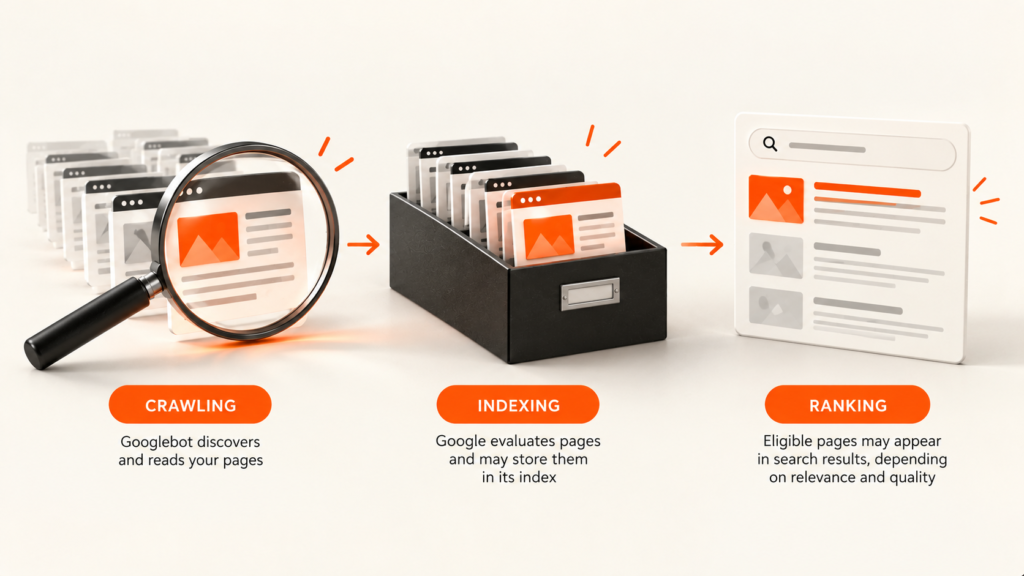
Crawling and indexing are related but different processes.
Crawling occurs when Googlebot accesses and reads a URL. Indexing involves evaluating a page and potentially storing it in Google’s search index. Ranking determines where an eligible page may appear in search results.
A page can be crawled without being indexed, and an indexed page may not rank prominently for its target keywords.
Therefore, if your website is not performing well in search results, investigate crawling, indexing, content quality, and relevance rather than assuming crawl budget is the main problem.
Conclusion
Crawl budget is a crucial aspect of technical SEO, especially for extensive websites, regularly updated sites, and those with intricate URL frameworks. Handling duplicate URLs, enhancing internal linking, keeping sitemaps accurate, and addressing server problems can assist search engines in finding important pages more effectively.
Nonetheless, optimizing crawl budget isn’t crucial for all websites. Small and medium-sized enterprises must initially confirm that their key pages are accessible, technically robust, well-connected, and beneficial to their audience.
The essence of managing crawl budget effectively is straightforward: assist search engines in prioritizing the most important pages. By integrating technical SEO strategies with a well-defined website layout and valuable content, you can create a more robust base for sustained organic search visibility.