
Introduction
For years, search has been built around keywords. We type a few words into a search bar, scan a list of links, and decide which result might contain the answer we need. But the way people search for information is changing rapidly.
Today, users are no longer simply searching for information. They are asking questions, explaining situations, requesting recommendations, and having conversations with technology. The future of search is moving from keywords to conversations.
This shift is changing not only how search engines work, but also how brands design websites, create content, and think about digital experiences.
From Brief Keywords to Organic Questions
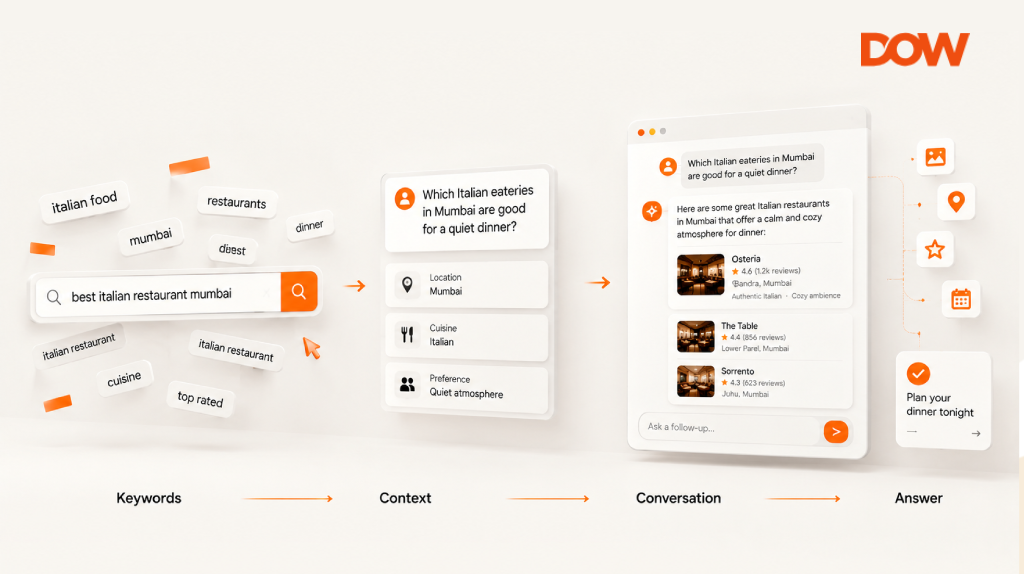
Conventional search frequently relies on brief, precise keywords. For instance, a person searching for a restaurant would look up:
“Mumbai’s best Italian restaurant”
Conversational search transforms this behavior into a more organic one:
“Which Italian eateries in Mumbai are good for a quiet dinner?”
Context, intent, and expectations are given in the second inquiry. Modern search systems are able to comprehend the user’s true intentions rather than just matching terms.
Artificial intelligence is crucial in this situation. In contrast to a standard search result, AI-powered search can parse natural language, comprehend context, connect similar material, and deliver results that feel more conversational.
The Search Process Is Growing More Human
Technology might not be the biggest shift. It’s behavioral. People ask questions and have discussions as a natural way to communicate. When we wish to tackle a problem, we don’t necessarily think in terms of keywords. We describe what we require.
For instance, rather than looking:
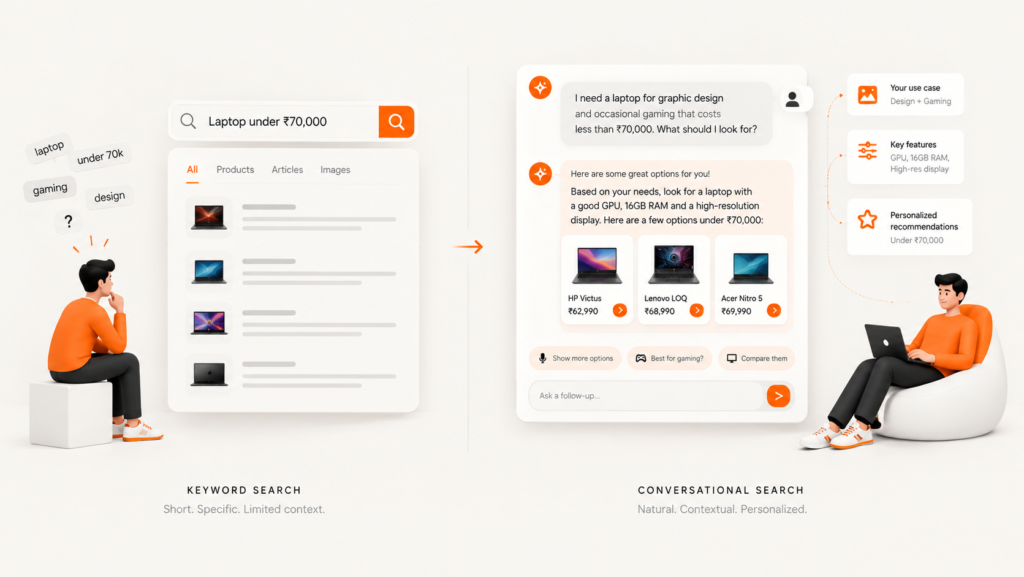
“Laptop for less than ₹70,000.”
A user may inquire:
“I need a laptop for graphic design and occasional gaming that costs less than ₹70,000. What should I search for? This provides a great deal more information about the user’s requirements to the search system.
The outcome is a search experience that may become more useful and personalized. The technology can assist users in solving a problem step-by-step rather than requiring them to search several times.
The Rise of AI-Powered Search
AI is changing the way people search for information. Search engines can now understand not just the words we type, but also the meaning, context, and intention behind our questions.
This means users can ask a question and then continue the conversation with follow-up questions.
For example:
“What is experiential marketing?”
Then:
“How is it different from digital marketing?”
And then:
“Can you give me an example from the pharmaceutical industry?”
Earlier, each of these searches would have been treated as a separate question. Today, AI-powered search can understand that the questions are connected and continue from the previous conversation.
As a result, search is becoming less about typing the right keywords and more about having a natural conversation to find the information you need.
What This Means for UX and UI Design
Additionally, this change is posing new difficulties for UI and UX designers.
A search box, a button, and a page of results have been the standard components of search interfaces for decades. However, designers must consider interaction, context, feedback, and continuity when using conversational search.
The interface could have to accommodate:
Follow-up inquiries
Recommended prompts
Voice communication
Customized outcomes
Visual data
Interactive responses
Unambiguous source citations
History of conversations
Helping users locate a page is no longer the only objective. It is to assist them in finishing a task.
That is a significant change in UX.
Websites Must Respond, Not Just Rank
Businesses used to place a lot of emphasis on ranking for particular keywords. While search exposure is still crucial, marketers are increasingly required to produce content that provides clear answers to actual user queries.
For instance, a business that sells industrial equipment shouldn’t just make a page that targets:
“Manufacturer of pharmaceutical equipment.”
Additionally, it may respond to queries like:
“How can I pick the best pharmaceutical equipment for my manufacturing line?”
either
“What aspects should I take into account before buying equipment for pharmaceutical manufacturing?”
Content that is based on actual user inquiries can show competence and offer more insight. This indicates that user intent, structured data, content quality, and the entire digital experience are all progressively becoming more tightly related to SEO.
Visual Search and Voice Will Expand the Conversation
Voice search enables people to communicate with technology in a natural way. Images can be used as queries in visual search. A product, structure, machine, or piece of furniture may be photographed, and someone may ask what it is or where they may buy something like.
This results in a multimodal search experience that integrates text, audio, graphics, and video.
This means that digital experiences need to be ready for a variety of information interaction methods for designers and companies.
The New Goal: Reduce the Distance Between Question and Answer
In the end, search has evolved into a movement that aims to minimize friction.
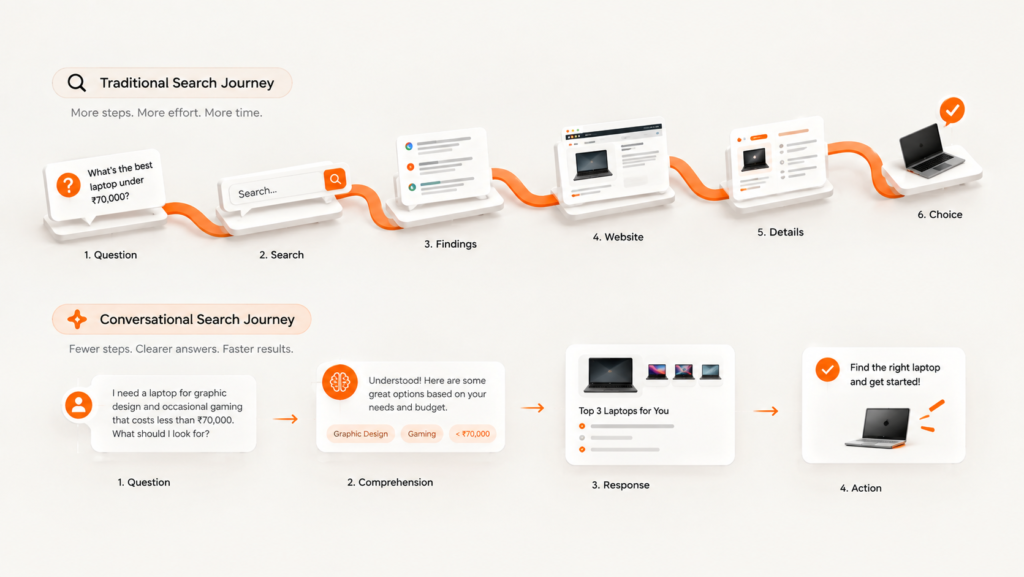
Conventional search requires users to do the following:
Question → Search → Findings → Website → Details → Choice
The goal of conversational search is to reduce that travel time:
Question → Comprehension → Response → Action
Websites won’t vanish as a result. Rather, their function might change. Websites can develop into reliable resources that offer more in-depth details, supporting data, goods, services, and firsthand accounts.
Designing for the Future of Search
Creating more intelligent search engines is not the only thing that will shape search in the future. Improving human-information interactions is the goal.
For brands, this is knowing what questions consumers genuinely ask. It entails writing for purpose rather than merely keywords for content producers. It entails creating experiences that facilitate dialog, context, and ongoing involvement for UX/UI designers.
The search bar is evolving into more than just a keyword entry box. It’s turning into a discussion starter.
Furthermore, the most effective digital experiences will be those that do more than just deliver information; they will comprehend users’ goals and assist them in achieving them as technology improves its comprehension of human communication.