


Introduction
Even with thousands of likes, an increasing number of followers, and a spike in website traffic, a marketing dashboard can tell you absolutely nothing about whether the company is truly expanding.
The problem is not the numbers themselves; it is what those numbers represent. A metric becomes valuable when it helps explain revenue, customers, conversions, profitability, or another measurable business outcome.
The key distinction between Vanity Metrics and Business Metrics is the difference between figures that are visually appealing and numbers that influence decisions.
What Are Vanity Metrics?
Vanity metrics are numbers that may appear impressive but don’t always offer useful information about how well a business is performing. They often create a positive impression because they show growth or activity, but they may not explain whether the business is actually becoming more successful.
Typical instances consist of:
Total number of followers on social media
Views of a website page
Likes and views of the video
Downloads of apps
Subscribers to emails
Total impressions
Consider a scenario where a company’s Instagram following grows from 10,000 to 50,000. This looks like great growth on the surface. However, the increase may have little commercial value if those extra followers are not interacting with the company, visiting the website, asking questions, or making purchases.
Vanity metrics are not always pointless. They can be used to show audience interest, reach, or awareness. When companies view them as the ultimate indicator of success, a problem arises.
What Are Business Metrics?
Business metrics, also known as actionable or performance metrics, are measurements that have a direct bearing on the objectives and results of an organization.
These indicators aid in providing answers to crucial queries like:
Are we making money? Do clients convert? Do we keep our customers? Do our marketing expenditures yield results?
Meaningful business metrics include, for instance:
Growth in revenue
Rate of conversion
Cost of acquiring customers (CAC)
CLV, or customer lifetime value
ROI, or return on investment
Conversion rate from leads to customers
Rate of customer retention
Margin of gross profit
The mean order value
Value of the sales pipeline
Vanity Metrics vs. Business Metrics
The easiest way to understand the difference is to look at the questions each metric answers.
A vanity metric could reveal:
How many individuals viewed our content?
A business metric queries:
How many of those individuals turned into qualified leads or clients?
Similarly, website traffic may tell you that 100,000 people visited your website. That sounds impressive. But if only 20 people submitted an inquiry, the business may need to investigate why visitors are not converting. However, a website with 1,000 quality leads and 20,000 visits can be much more beneficial.
Activity and influence are the main distinctions.
Why Businesses Get Distracted by Vanity Metrics

Vanity metrics are appealing because they are simple to comprehend and can have striking visuals. A graph that displays a sharp rise in website traffic or followers may appear to be making good progress.
They may be helpful for communication as well. One million impressions from a campaign can make a marketing team proud.
Businesses also prioritize vanity metrics because they are frequently simpler to enhance. For instance, it might be simpler to increase social media impressions than revenue. Improving a figure just because it looks good, meanwhile, does not always translate into better business.
How to Identify the Metrics That Matter
Linking measurements to particular business goals is the first step.
If the goal is Revenue Growth, track metrics such as sales revenue, average order value, conversion rate, and customer lifetime value.
If the goal is Customer Acquisition, focus on qualified leads, customer acquisition cost, lead conversion rate, and sales generated from each channel.
If the goal is Customer Retention, monitor repeat purchase rate, churn, retention rate, and customer lifetime value.
Converting Vanity Metrics into Business Metrics
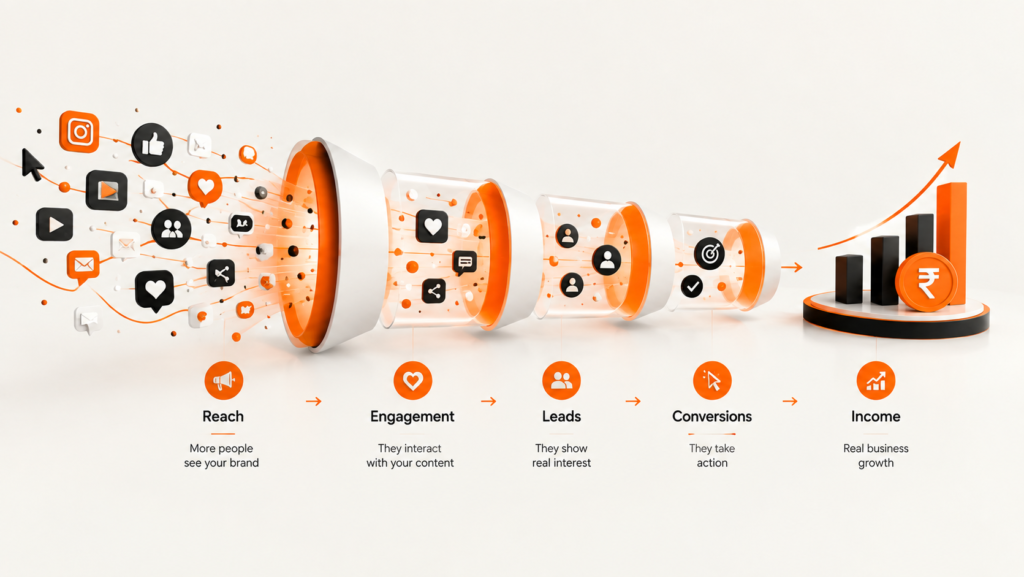
Ignoring vanity metrics entirely is not the answer. Rather, companies ought to link them to significant results. Rather than concentrating solely on 100,000 website views, monitor the number of visitors who finish a desired action.
Examine the number of visitors who clicked through, asked for information, or ultimately became customers rather than celebrating one million video views.
This establishes a measuring chain:
Reach → Engagement → Leads → Conversions → Income
A metric’s value for making decisions increases with its degree of connection to real business outcomes.
Build a Culture Around Business Impact
Successful organizations do not measure everything simply because they can. They identify the metrics that support their objectives and use them consistently.
Marketing teams need to know how campaigns affect sales. Sales teams should be aware of the expenses and profitability of acquiring new customers. Leadership should assess the general well-being of the company and look beyond apparent growth.
Leading indicators, such as qualified leads and engagement, can provide early signals of future performance. Lagging indicators, such as revenue and profit, show the actual outcomes.
Together, they provide a more complete picture.
Conclusion
Data is only useful when it enables a company to comprehend its situation and make decisions about its future course of action.
Vanity metrics should not be used to define success, but they can offer helpful information regarding awareness and activity. By linking performance to customers, sales, profitability, and long-term growth, business measurements go deeper.
Gathering additional data is not the objective. Measuring the correct figures is the aim.